Manufacturer: Renault

  • Renault 4 E-Tech Electric Car Review

    Renault 4 E-Tech Electric Car Review

    The Renault 4 is one of those names that means something. The original was built to be simple, tough, and useful. Not a fashion item, just a car that got on with life.

    Renault’s new Renault 4 E-Tech electric keeps that spirit, but wraps it in a modern EV package that feels aimed at people who like the Renault 5 E-Tech’s style, but want something more practical. 

    It sits on Renault’s small EV platform, it has a slightly taller stance than the 5, and it brings a big headline for family life: a 420-litre boot. That’s a strong number for a car in this size bracket, and it immediately tells you what the Renault 4 is here to do. 

    So, is it just a Renault 5 with a different coat on, or is it a properly useful little electric car in its own right?

    Quick spec highlights

    • Battery: 52kWh 
    • Power: up to 150hp
    • Range: up to 249 miles (WLTP)
    • DC rapid charging: up to 100kW, 15–80% in around 30 minutes
    • Boot: 420 litres (and up to 1,405 litres with seats folded) 

    Design and road presence

    Renault has absolutely leaned into the nostalgia, but without making it feel like a costume.

    Up front, the lighting is the star. The Renault 4 has a really distinctive face, with a modern light signature that gives it instant recognition at night, and it feels like Renault is building a proper identity across its new electric range. 

    From the side, it’s clear this is the “more practical” choice next to the Renault 5. It has a slightly tougher, more upright look and a bit more visual bulk, but it still feels compact enough for UK roads and car parks.

    There are also some nice little nods to the original Renault 4’s shape, including the rear quarter window detail that immediately gives it that classic silhouette, but modernised.

    At the rear, it stays clean and simple, and it looks like a car designed to be used rather than just admired. Which is exactly what the Renault 4 badge should stand for.

    Interior and infotainment

    Renault’s recent interiors have been a pleasant surprise, and the Renault 4 continues that run.

    You get Renault’s OpenR Link set-up with a 10.1-inch central touchscreen across the range, and depending on trim, you can have Google built-in for proper integrated navigation and apps. 

    The best bit is usability.

    Renault hasn’t buried everything in touch menus, so it still feels like a car you can jump into and just get on with. If you spend a lot of time in traffic or doing school runs, that matters more than people admit.

    Sound system wise, it’s strong for a standard set-up. It’s not the best you’ll ever hear, but it’s clearly better than plenty of default systems in this class.

    Space and practicality

    This is where the Renault 4 makes its strongest case.

    That 420-litre boot is not just a headline number. Renault has also focused on the details that make it easier to live with, like an easy-to-load shape and a low loading height. 

    You also get space under the boot floor for charging cables, which helps keep the main boot area clean and usable. 

    Fold the rear seats and you can expand the load space to up to 1,405 litres, which is more than enough for bikes, tip runs, flat-pack furniture, or a family weekend away without playing luggage Jenga. 

    Up front, the cabin has a practical feel too, with plenty of storage and a layout that suits daily driving rather than showing off.

    In the back, it’s not huge, but it’s noticeably more forgiving than a smaller supermini-style EV. If you regularly have adults in the rear, or you’re dealing with child seats, this is the version of Renault’s retro EV idea that makes more sense.

    Driving impressions

    This section is always personal, but on paper the Renault 4 is set up to feel lively rather than lazy.

    With up to 150hp, it has enough shove for town driving and quick A-road bursts, and it should feel brisk without being “hot hatch” intense. 

    The spec also leans into making EV driving easier:

    • One Pedal driving is available from certain trims, designed to make stop-start driving smoother and less tiring. 
    • Driver assistance features and cruise control options vary by trim, but the aim is clearly “easy daily use” rather than gimmicks. 

    In corners, the Renault 4 should feel tidy and confidence-inspiring for what it is. It’s not trying to be a sports car. It’s trying to feel light, friendly, and predictable. That’s what most people actually want.

    Range and charging

    The Renault 4’s core UK set-up is a 52kWh battery with a quoted range up to 249 miles (WLTP). 

    Real-world range will always depend on temperature, speed, wheels, and how heavy your right foot is, but on paper it sits in a sweet spot for a UK family EV. It’s enough for commuting and local life with plenty of buffer, and it can handle longer trips if you’re happy to rapid charge.

    Charging is solid for the segment:

    • Up to 100kW DC rapid charging
    • Renault quotes 15–80% in around 30 minutes on a suitable rapid charger 

    That’s the kind of charging performance that makes “day trip EV” life feel simple, rather than stressful.

    Trims, pricing, and which one to buy

    Renault keeps the line-up straightforward with three trims:

    • evolution
    • techno
    • iconic

    UK pricing starts from £26,995 OTR for evolution, rising to £28,995 for techno and £30,995 for iconic. On a Personal Contract Hire lease agreement, the deals are pretty strong with monthly payments from around £275 per month (Feb 2026) with Rivervale.

    Which one makes most sense?

    For most people, techno will likely be the sweet spot. It tends to be the trim where you get the best blend of the “nice-to-have” tech without the full price jump into the top version. 

    If you want a simpler spec and you just care about the core EV experience, the entry trim will still appeal, especially with that practical shape and boot doing the heavy lifting.

    If you want all the comfort extras, stronger driver assistance, and the most premium feel, iconic is the one to go for, but it depends how much you value those upgrades.

    Rivals and where it fits

    The Renault 4’s best comparison is actually inside Renault’s own showroom.

    If you love the idea of a retro Renault EV, the choice is basically:

    • Renault 5 E-Tech: style-first, supermini vibe
    • Renault 4 E-Tech: more space, more boot, more everyday flexibility 

    Outside of Renault, you’re looking at small electric crossovers and compact EVs that try to balance city-friendly size with family-friendly practicality. The Renault 4’s advantage is that it doesn’t feel generic. It has personality, and the boot space gives it a clear reason to exist.

    Verdict

    The new Renault 4 E-Tech electric gets the brief right.

    It looks interesting, it feels like part of Renault’s confident new era, and it offers something the Renault 5 can’t: proper practicality, led by that 420-litre boot and a more usable everyday shape. 

    It also hits a sensible balance on EV fundamentals: up to 249 miles of quoted range, 100kW rapid charging, and a power output that should feel punchy without being over the top. 

    If you want an electric car that feels modern, has character, and still works for normal life, the Renault 4 is a very easy one to recommend.

    Renault 4

    Ben Freakley

    Performance: How quick it feels day to day. Power, throttle response and smoothness.
    Handling: How it corners and how stable it feels on different roads.
    Comfort: Ride quality, seating, refinement and road noise.
    Tech and Infotainment: Screens, CarPlay, clarity, speed, app controls, driver aids.
    Ease of Use: How simple the cockpit is. Buttons vs touch. Clear menus. Good ergonomics.
    Space and Practicality: Boot size, rear room, storage, access, visibility.
    Running Costs: Real world range, charging speed, fuel use, tax, servicing.
    Build Quality: Materials, fit and finish, how solid it feels inside.
    Value for Money: How much car you get for the price.

    Summary

    The Renault 4 E-Tech is another retro-inspired electric hatch that doesn’t compromise modern usability.

    It handles extremely well and has all the toys you’d want. The rear seats are a little tighter than I expected. The battery size limits heavy motorway use, but as a useable everyday car this is a great option.

    If you’re in the market for an EV that stands out, is easy to live with and offers strong tech, this is a very compelling option. I give it 4.4 out of 5 stars.

    4.4

    Frequently Asked Questions About the Renault 4 E-Tech

    What is the Renault 4 E-Tech electric?

    It’s Renault’s new small electric crossover-inspired hatch that revives the Renault 4 name, with modern EV tech and a focus on everyday practicality.

    What is the range of the Renault 4 E-Tech?

    Renault quotes up to 249 miles (WLTP) for the UK model with the 52kWh battery.

    How fast can it charge?

    It supports up to 100kW DC rapid charging, with a quoted 15–80% charge in around 30 minutes on a suitable rapid charger.

    How big is the boot?

    The boot is 420 litres, expanding to up to 1,405 litres with the rear seats folded.

    What trims are available in the UK?

    There are currently three spec/trim levels available: evolution, techno, and iconic.

    How much does the Renault 4 E-Tech cost in the UK?

    Prices start from £26,995 OTR, with techno at £28,995 and iconic at £30,995.

    Can you get a lease deal on a Renault 4 E-Tech?

    Yes. It’s available on either a personal or business lease deal from car leasing brokers like Rivervale.

    Is it better than the Renault 5 E-Tech?

    If you want the most style-led, compact option, the Renault 5 is the one. If you want more boot space and an easier day-to-day shape, the Renault 4 makes more sense.

    Does it have Sat Nav built in?

    Depending on trim, you can have OpenR Link with Google built-in for navigation and apps.

  • Renault Filante. A bold new name with serious intent.

    Renault Filante. A bold new name with serious intent.

    Renault has officially revealed Filante, its new high-end crossover and the most important international model the brand has launched in years.

    This is no concept tease or naming exercise anymore. Filante is real, fully revealed, and positioned as Renault’s new global flagship outside Europe.

    Not a trim level.
    Not a market-specific spin-off.
    A clear statement of intent.

    Filante sits at the top of Renault’s international range and plays a central role in the brand’s 2027 International Game Plan. This is Renault pushing properly upmarket, with confidence.

    Renault Filante

    Filante is more than a name

    It’s a manifesto

    The name Filante was never chosen lightly, and now the full story is clear.

    It connects three key strands of Renault heritage:

    • Étoile Filante (1956), the aircraft-inspired record car that exceeded 300 km/h
    • Filante Record 2025, the electric concept that covered 1,008 km in under 10 hours at motorway speeds
    • The “étoile” badge used on Renault’s most prestigious models in the 1930s

    Together, they point to speed, efficiency, long-distance comfort and premium ambition.

    Filante is not just meant to sound aspirational. It is designed to carry meaning.

    Renault Filante Rear

    Exterior design

    Assertive, avant-garde and unmistakably premium

    Renault describes Filante as bold and charismatic, and the design backs that up.

    Key themes include:

    • A strong, sculpted stance in the E segment
    • A dramatic new light signature that gives Filante instant presence
    • Clean surfaces combined with sharp detailing
    • An aerodynamic rear designed to balance style with efficiency

    This is a long way from safe, anonymous crossover design. Filante looks confident, modern and deliberately different.

    French design flair, turned up a notch.

    Renault Filante Interior

    Interior design

    Lounge-level comfort with a high-tech edge

    Inside, Filante leans heavily into comfort, calm and refinement.

    Highlights include:

    • Lounge-style seats for every occupant
    • High levels of soundproofing for long-distance comfort
    • Customisable ambient lighting
    • A cabin designed around wellbeing rather than visual clutter

    Renault is clearly targeting customers who want space, comfort and technology without the stiffness or formality that can come with traditional premium brands.

    Renault Filante Front

    Technology and driving aids

    Smarter, calmer, more personal

    Filante introduces one of Renault’s most advanced digital environments to date.

    Key features include:

    • A fully connected, personalised infotainment system
    • Over-the-air updates
    • My Renault app integration for remote vehicle control
    • New-generation driver assistance systems

    Three safety features make their debut on a Renault:

    • Emergency steering assist
    • Smart rear-view mirror
    • Child presence detection

    The emphasis is not just on innovation, but on reducing stress behind the wheel.

    Renault Filante Race Car

    Powertrain

    Full hybrid E-Tech 250

    Renault Filante launches with an upgraded full hybrid E-Tech 250 ps powertrain.

    What we know so far:

    • New-generation hybrid system developed by the Alliance
    • Dual electric drive for smoother, more responsive performance
    • Multimode automatic gearbox
    • Designed to balance strong performance with efficiency

    This is not a plug-in hybrid and not a full EV. It’s a clear signal that Renault still sees advanced hybrids as a key part of its global strategy.

    Renault Filante Launch

    Korea first, then the world

    Filante will be built at Renault’s Busan plant in South Korea and launched there in March 2026.

    That decision is deliberate.

    South Korea has a strong appetite for premium D and E segment vehicles, and SUVs dominate the space. Filante is designed to meet local expectations while acting as a showcase for Renault’s international direction.

    From Korea, Filante will roll out to:

    • Parts of South America from late 2026
    • Gulf States in early 2027

    Europe is not currently part of the plan.

    Renault Filante Rear Seats Interior

    Why Filante matters

    This car is bigger than one model.

    Filante represents:

    • Renault’s most confident move upmarket outside Europe
    • A return to premium thinking rooted in heritage
    • A design-led, technology-forward flagship
    • A bridge between bold concept cars and real production models

    It also shows how extreme projects like Filante Record 2025 are feeding into mainstream vehicles, especially around efficiency, aerodynamics and long-distance comfort.

    Ben Talks Auto take

    Filante feels like a turning point.

    Renault has been quietly building momentum. Stronger design. Clearer identity. Better electrified tech. Filante pulls all of that together into one car.

    This is not Renault chasing German premium brands head-on. It’s Renault defining its own version of premium, one rooted in comfort, character and calm confidence.

    We still need pricing, real-world driving impressions and full specs. But on design, intent and positioning alone, Filante already feels like one of the most important Renaults of the decade.

    Not just a new crossover.
    A signal of intent.

  • Renault and Ford Team Up to Build Two New Affordable Electric Cars for Europe

    Renault and Ford Team Up to Build Two New Affordable Electric Cars for Europe

    Renault Group and Ford have announced a major new partnership that will reshape the electric car market in Europe. The two brands will work together on a pair of affordable Ford-branded electric cars, both using Renault’s Ampere platform. Production will take place in northern France, with the first model planned for early 2028.

    This is one of the most significant alliances we’ve seen in Europe’s EV market for years. It brings together Renault’s fast-growing electric know-how with Ford’s design strengths and driving feel. For buyers, it should mean better value, more choice and genuinely competitive electric cars that don’t cost the earth.

    What the partnership means

    The agreement covers two main areas:

    Two new Ford electric cars built by Renault

    Ford will design the vehicles, but underneath they will use Renault’s Ampere platform. This is the same EV architecture helping Renault roll out more efficient, lower-cost electric models. The cars will be developed jointly, built by Renault in France and given a full Ford identity in terms of handling, tech and interior feel.

    The first car is expected to reach European showrooms in early 2028 and marks the start of a fresh product push for Ford in the region.

    Could this mean the return of the Fiesta?

    Ford hasn’t confirmed what the two new electric models will be, but the timing has already sparked plenty of speculation. With the Fiesta bowing out in 2023 and leaving a huge gap in Ford’s small-car range, many buyers are wondering whether this partnership could pave the way for an electric revival of one of Britain’s best-loved cars.

    An affordable EV built on Renault’s Ampere platform could be the perfect foundation for a modern, compact Ford. Nothing is announced yet, but if the brand wants to reconnect with the millions of drivers who grew up with a Fiesta, this partnership might be the moment to do it.

    Planned collaboration on vans

    Alongside the passenger cars, Renault and Ford have signed a Letter of Intent to explore a shared approach to selected light commercial vehicles. If it goes ahead, both brands could co-develop and manufacture certain vans for the European market. Given how strong both companies are in this segment, this could become a big deal for fleets and small businesses looking to go electric.

    Why this matters

    Europe’s EV market is becoming more competitive by the week. Manufacturers are under pressure to cut costs, reduce complexity and speed up development. This partnership gives both companies what they need:

    • Renault gains extra scale for its Ampere platform and its ElectriCity production hub in northern France.
    • Ford gains access to proven EV underpinnings while focusing on its strengths in design, driving character and customer experience.

    Both CEOs were clear that this alliance is about staying competitive in a fast-shifting industry. Renault’s François Provost described Ford as “an iconic car manufacturer”, while Ford’s Jim Farley said combining forces would help them build “fun, capable, and distinctly Ford” electric cars.

    What buyers should expect

    While details about the two electric cars are still under wraps, a few things are already clear:

    • Expect affordable pricing, as both brands want these models to hit the mass market.
    • The cars will carry Ford’s design language and driving feel, not a rebadged Renault.
    • The Ampere platform should allow for good efficiency, competitive range and fast-charging capability.
    • Production in France helps reduce supply chain pressures and means shorter transport distances for European customers.

    If this partnership delivers on its aims, these two EVs could become important alternatives to the growing number of Chinese-built electric cars arriving in Europe.

    A smarter way of working

    What stands out about this deal is how open both companies are to pooling resources. Legacy manufacturers are often slow to collaborate, but Renault and Ford clearly see value in teaming up where it makes sense. It also shows how flexible modern EV platforms have become, letting completely different brands create their own identity on top of shared foundations.

    This is just the starting point. If the two passenger cars are successful, and if the van collaboration moves forward, we could see a much wider Renault–Ford partnership in the future.

    Final thoughts

    For European buyers, this is promising news. More choice, better value and the chance to buy a Ford EV built using one of the most competitive electric platforms on the continent.

    As soon as more details surface on the new models, I’ll cover them here on Ben Talks Auto. If Ford gets the pricing and design right, these cars could become some of the most important electric models of the late 2020s.

  • Renault 5 E Tech Electric Wins ‘EV of the Year’ at the Motor Trader Industry Awards 2025

    Renault 5 E Tech Electric Wins ‘EV of the Year’ at the Motor Trader Industry Awards 2025

    Renault has done it again. The Renault 5 E Tech Electric has been crowned ‘EV of the Year’ at the Motor Trader Industry Awards 2025. It’s a huge moment for one of the most talked-about small EVs on the market, and I’m not surprised at all. The R5 has been my favourite city car since I first drove it. It’s stylish, light on its feet and has the right mix of charm and everyday usability.

    This win comes on the back of strong competition from Europe and Asia. Even with the pressure of new rivals arriving every month, the Renault 5 still stands out. The judging panel praised its design, pricing and tech, calling it a breath of fresh air in the supermini EV segment. With battery choices of 40 kWh or 52 kWh and a range of up to 252 miles, it delivers the right amount of performance for daily driving without pushing the price out of reach.

    Prices start from £21,495 on the road thanks to the UK Government Electric Car Grant. It’s not often you get this level of style and capability at that price point. Renault has also done well to balance retro cues with modern tech. The R5 feels familiar yet fresh, and the vibrant colour palette only adds to its appeal.

    It’s worth remembering that this is the second year in a row Renault has impressed the Motor Trader judges. Last year the Scenic E Tech Electric took home the ‘New Car of the Year’ title. That momentum continues with the R5, which has quickly become one of the most desirable electric hatchbacks in the UK.

    Ben Freakley and Rocio Artist with the Renault 5
    Ben Freakley and Rocio Artist reviewing the Renault 5 in Brighton

    If you want to know what it’s like to live with, I’ve already done a full review after spending a week with the car.

    The award feels well deserved. The R5 captures the original’s spirit and brings it into today’s world with confidence. It’s good to see a small EV winning big.

  • Renault Trafic E Tech Electric Revealed

    Renault Trafic E Tech Electric Revealed

    Renault’s next generation electric van takes a big step forward

    Renault has revealed the new Trafic Van E Tech Electric, the next generation of its medium electric van. This is not the first electric Trafic, but it is the first to sit on a dedicated all electric skateboard platform. It brings a big jump in range, charging speed and software, turning the Trafic into a far more capable EV for business users. It will arrive in late 2026.

    The launch also comes at a time when the medium van market is more competitive than ever. The Ford Transit Custom continues to lead UK registrations, while brands like Maxus and newcomers like Farizon have pushed EV technology forward. I reviewed the Farizon SV earlier this year and this new Trafic feels very much aimed at meeting that new standard. Smart design, long range and proper digital features are now essential, not optional.

    SMMT figures show the Renault Trafic sits sixth in UK sales this year with 9,905 registrations from January to October. So this new model has a real opportunity to strengthen Renault’s position in a busy segment.

    Battery, range and charging

    Renault will offer two battery options.

    • Long range NMC battery. Up to 450 km WLTP which is about 280 miles
    • Urban range LFP battery. Around 350 km WLTP which is about 217 miles

    New 800V charging means a 15 to 80 percent top up takes around 20 minutes and adds up to 260 km which is about 162 miles.

    A new 150 kW motor produces 345 Nm of torque. Renault says the van will offer a towing capacity of 2 tonnes and payload up to 1.25 tonnes once homologated.

    These figures put the Trafic E Tech Electric among the longest range electric medium vans currently announced.

    How it compares to its rivals

    Ford E Transit Custom

    • Up to 337 km (about 209 miles) WLTP from a 64 kWh battery
    • Strong dealer network and familiar driving feel
    • The Trafic offers higher quoted range and much faster 800V charging, but Ford still has the stronger brand loyalty

    Farizon SV

    • 67 to 106 kWh batteries with ranges from roughly 188 to 247 miles WLTP
    • Some versions claim up to 342 miles in city conditions
    • I reviewed this earlier in the year and was impressed by the finish and value. The Renault counters with a more advanced software platform and stronger long range capability

    Maxus eDeliver 7

    • Up to around 230 miles depending on version
    • Well equipped and affordable with good real world usability
    • The Trafic promises longer range and a far more modern digital cabin, while Maxus remains the value choice

    Renault has not released pricing yet, so the true comparison will become clearer once costs are confirmed.

    Design, space and practicality

    The new skateboard layout shortens the front overhang and places the motor at the rear. Renault says this gives the van a turning circle of 10.3 metres which is as tight as a Clio. This should be a big help when working in towns and cities.

    Two body lengths will be available.

    • L1 at 4.87 metres with 5.1 cubic metres of load space
    • L2 at 5.27 metres with 5.8 cubic metres of load space

    Height stays below 1.90 metres so it fits into standard underground car parks. Wide side and rear doors allow easy loading of Euro pallets.

    The cabin has been designed around real day to day use with plenty of storage including shelves, cubbies, large door bins and a secure area near the base of the windscreen made from 50 percent plant based fibres.

    Software, tech and safety

    This is Renault’s first commercial vehicle built on the new SDV software defined architecture from Ampere. All computing power is centralised, allowing smooth updates and feature upgrades over time.

    The cabin features a 10 inch digital cluster and a 12 inch central screen running Android Automotive OS. Google Maps, Assistant and a full app library come built in. The route planner can account for vehicle size, load and charging needs.

    Vehicle to Load and Vehicle to Grid features are included so tools, equipment or even a site office can be powered directly from the van.

    Safety Coach and Safety Monitor track driving behaviour, offer coaching and display a live safety score. The My Renault app supports charge scheduling, preconditioning, remote lock checks and maintenance tracking.

    Why this matters

    The electric medium van segment is moving quickly and businesses now want longer range, fast charging and strong digital tools. Ford continues to dominate. Maxus delivers good value. Farizon has entered the market with a modern, ground up EV approach.

    The new Trafic E Tech Electric looks ready to compete with all of them. Range up to 280 miles, ultra fast 800V charging, a modern design and a software heavy cabin make it a serious contender. If pricing lands in the right place, this could become one of the strongest all round electric vans available.

    I will test the production model as soon as it becomes available. After spending time with the Farizon SV, I am keen to see how the new Trafic performs in the real world.

  • Renault Twingo E-Tech Electric: The City Car Returns with a Modern Twist

    Renault Twingo E-Tech Electric: The City Car Returns with a Modern Twist

    The Renault Twingo is making a comeback, and this time it’s electric. Set to arrive in the UK in early 2027, the new Twingo E-Tech Electric promises to bring the charm and simplicity of the original 1990s icon into the electric era.

    A quick look

    • Price: Expected from under £20,000
    • Power: 60 kW (82 bhp)
    • Range: Up to 163 miles (WLTP)
    • Battery: 27.5 kWh LFP unit
    • Charging: 6.6 kW AC (11 kW AC and 50 kW DC optional)
    • Top speed: 81 mph
    • Availability: Early 2027 (UK)
    Renault Twingo e-tech Wheels

    A small car with a big legacy

    When the first Twingo launched back in 1992, it was something of a design revolution, small, friendly, and full of personality. Over 4 million were sold across 25 countries, and it quickly became a symbol of clever, affordable mobility.

    Fast-forward 30 years and Renault wants to recapture that spirit for the electric age. The new E-Tech model is built around affordability, simplicity, and fun. Renault says it’s the first car in its “Leap 100” programme, developed in just 100 weeks, showing how quickly the brand is moving to bring EVs to everyone.

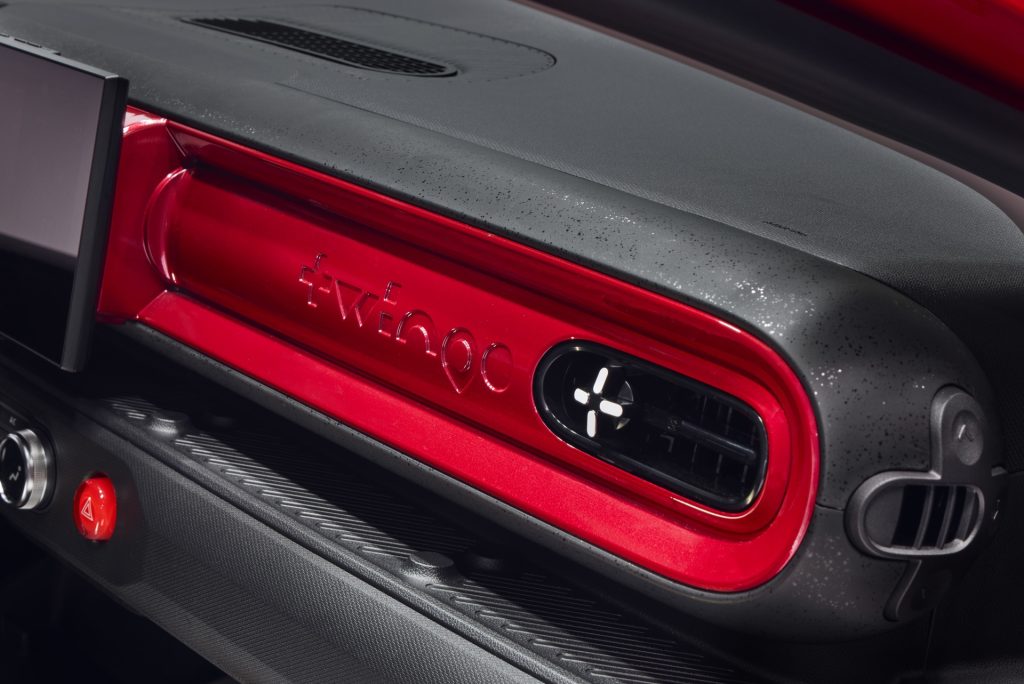
    Renault Twingo e-tech Interior Detailing

    Designed for urban life

    The Twingo E-Tech Electric is a five-door city car that looks cheerful and minimalistic, with clear nods to the original’s smiley face and curved lines. Inside, it’s neat and uncluttered, featuring a dual-screen layout with Google built-in and Apple CarPlay as standard.

    At just 3.79 metres long, it’s easy to park and nimble to drive; yet still offers impressive space. The rear seats slide independently to boost boot capacity up to 360 litres, or over 1,000 litres with the seats folded, clever for such a compact car.

    Renault Twingo e-tech Interior

    Electric power made simple

    The 60 kW motor and 27.5 kWh LFP battery deliver up to 163 miles of range, making this a perfect everyday commuter. A 0–50 km/h (31 mph) sprint in 3.85 seconds keeps it lively in city traffic, and with One-Pedal driving on the higher Techno trim, it’s smooth and effortless to use around town.

    Renault is also keeping running costs low, thanks to LFP battery tech that’s cheaper and longer-lasting. Charging is straightforward too; 4 hours 15 minutes on a home wallbox or 30 minutes for 10–80 percent on a fast charger.

    Renault Twingo e-tech Rear Light

    Looking ahead

    I’m really looking forward to seeing this one in the flesh. The new Twingo looks full of personality, feels practical for city life, and could be the perfect starter EV for many buyers.

  • Renault 5 Electric Review

    Renault 5 Electric Review

    The Renault 5 E‑Tech is a bold re-imagination of the classic 1970s hatchback. Over a week of driving it, I found it stylish, fun and genuinely usable for daily life. It won’t be perfect for everyone, but for those looking for a punchy, compact EV with personality, it’s hard to beat.

    Headline numbers

    • Price (UK) : approx £22,995 – £30,000+ depending on battery and trim
    • Trims : Evolution, Techno, Iconic Five (plus special editions)
    • Battery options : 40 kWh (Urban Range) or 52 kWh (Comfort Range)
    • Motor options : 90 kW (≈120 hp) or 110 kW (≈150 hp)
    • Real-world range : ~185-190 miles for 40 kWh; about ~250 miles for 52 kWh (book ~252 miles)
    • Charging : home charging overnight possible; rapid public charging 15-80% in ~30 minutes under good conditions
    • Boot & practicality: surprisingly generous for its size; good for everyday use.
    • Availability : On sale now
    • Leasing note: Excellent prospect for personal or business lease, thanks to its price, residual value, tech and appeal.
    Road trip to Renault Douai Factory

    First look

    The moment you walk up to the Renault 5 E-Tech you’ll notice its presence. The sharp lines and retro cues shout personality. In my week with it I found the bold colour and contrasting roof made it stand out in traffic and car parks alike.

    Auto Express describes it as:

    “well-priced, nice to drive, and has great tech”.

    Meanwhile Carwow highlights how it “blends everyday usability with a reasonably long range, fun driving character and a massive dose of retro charm”.

    My early impressions: controls feel familiar and intuitive, the driver environment feels intuitive and uncluttered. In an era where many EVs complicate the user experience with overly layered menus, this one keeps things refreshingly simple – a big plus.

    Design & cabin

    Exterior Design

    • The example I drove had a vivid yellow paint and black roof, it turned heads, just as expected.
    • Gloss-black wing mirrors, red detailing around the doors, diamond-cut alloy wheels, all combine to create that “funky hot-hatch” look.
    • Up front: minimal grille, flush lines, a clever LED badge/display where an air-intake would be on a petrol car. Details like those make a difference.
    • Rear: The styling is instantly recognisable as a Renault 5 lineage car, stacked LED lights, a carbon-effect trim across the boot lid and that cheeky silhouette.
    • Practical touches: Hidden door handles, rear tinted windows, 360° parking sensors all contribute to usability. In tight urban spaces I found it very easy to manoeuvre in and out.

    Interior / Cabin

    • Seats: My test car had mustard-toned upholstery with retro-style “5” embroidery. I wasn’t personally a fan of the colour choice, but the build and bolstering were good.
    • Dashboard: Leather-effect top, yellow stitching matching seats, gloss-black trim, illuminated Renault 5 branding, visually attractive and well finished.
    • Infotainment and tech: This is a highlight. The built-in Google apps, voice activation, personalisation of ambient lighting (you can cycle through all colours, choose your own) – very slick. Carwow calls the system “one of the best I’ve used in a long time”.
    • Boot and daily practicality: For a car of this size the boot is better than many expect. There’s a false floor with space underneath for your charging cable (which I found very handy). Rear seats are usable but not generous for tall adults on lengthy trips.
    • Rear cabin: Legroom is limited. I sat behind my driving position and felt the constraint. It’s fine for shorter runs or smaller passengers, but if you regularly move four tall adults and luggage it might feel compromised.

    Space & practicality

    For the “city plus commuting” use-case this car is very strong. It’s compact, easy to maneuver and park, while still offering enough space for daily errands, school runs and short motorway stints. Visibility is good and the parking cameras + sensors give confidence in tight spots. The build quality is better than I expected; according to Top Gear, the chassis feels “remarkably rigid… we can’t recall driving a supermini with better-insulated suspension noise.”

    If your requirement is a full-sized family car with lots of rear cabin and boot volume then this may not be the optimum choice, but that’s not what the Renault 5 E-Tech sets out to be.

    On the road

    City driving: The instant torque that electric motors offer is well exploited here. Whether pulling away from a junction or merging into traffic I found the car responsive and agile. Even in Eco mode it felt composed; flicking into Sport added some heft to the steering and enhanced the feel.

    B-roads and dual-carriageways: The ride is tighter than a budget hatch might be, but composed. Adaptive cruise and lane-keeping assist contribute to comfort on longer stretches; I used those on a dual-carriageway and found things calm and stable. The blind-spot monitoring worked well when switching lanes.

    Motorway use: The 52 kWh battery provides enough to make motorway use viable, though frequent 70 mph stretches will inevitably reduce range.The Renault 5 is not only a fantastic car for around-town driving, it’s more capable on the motorway than you might expect.

    Range & charging

    In my week with the 52 kWh version I found ~250 miles realistic in mixed use (urban + some A-roads + motorway). That lines up with the quoted 252 miles in the specs. The 40 kWh version gives lower range (185-190 miles) but still sufficient for many city-commute users.

    Charging: overnight home charging (7 kW) comfortably covers a full charge for daily use. Public rapid chargers: under optimal conditions you can go from ~15-80% in about 30 minutes. As ever with EVs, planning matters: check charger availability, consider your real-world usage, factor in weather and highway speeds which reduce range.

    Trims & pricing (buying tips)

    • Entry-level (~£22,995) gets you into the 40 kWh version with good kit.
    • Step up to the 52 kWh version (~£26k-£30k) for extra range and more power.
    • Bold colour choices (like Pop Yellow) add personality but can cost more and may affect resale.

    My advice:

    • If your commute is under ~50 miles and you mainly drive urban and peri-urban, the 40 kWh version could hit the sweet spot for cost.
    • If you regularly drive longer distances or want more flexibility (and occasional motorway use) the 52 kWh is worth the premium.
    • Choose a standout colour if you value the ‘fashion’ element.
    • Explore leasing: given the footprint of the car and the reduced running costs for an EV, it’s a compelling option.

    Rivals

    • Mini Electric: similar size and premium feel, but in many opinions the Renault 5 gives more space/practicality plus stronger design character.
    • Vauxhall Corsa Electric: more conventional hatch shape, very credible offering; the Renault wins on personality. Carwow compares them.
    • Peugeot e‑208: stylish and fun to drive, a strong contender; but again the Renault’s tech and retro styling give it a unique appeal.

    Safety & ownership

    Safety systems: The car comes with modern driver aids – adaptive cruise, lane-keeping assist, blind-spot monitoring, parking sensors/cameras front and rear. I found them all well-calibrated (i.e., not intrusive). Build quality is very good for this class. Plus the suspension noise insulation is class-leading.

    Ownership: EV running costs are low, no fuel, lower servicing. Renault offers a standard warranty; charging infrastructure remains the owner’s responsibility to plan. Auto Express awarded the Renault 5 “Affordable Electric Car of the Year 2025”.

    Who should buy/lease

    Great choice if you:

    • Live in urban/suburban areas and want an EV with flair.
    • Value design, tech and personality as much as practicality.
    • Mostly drive two to four people and don’t regularly need huge rear cabin space.
    • Want a compact car that’s easy to park and runs cheaply.
    • Are leasing or buying with an eye on cost-effective EV ownership.

    Less ideal if you:

    • Regularly carry four tall adults plus luggage on long trips.
    • Need maximum range or the most rapid charging performance available.
    • Prefer conventional styling and aren’t interested in stand-out looks.

    Renault 5

    Ben Freakley

    Performance: How quick it feels day to day. Power, throttle response and smoothness.
    Handling: How it corners and how stable it feels on different roads.
    Comfort: Ride quality, seating, refinement and road noise.
    Tech and Infotainment: Screens, CarPlay, clarity, speed, app controls, driver aids.
    Ease of Use: How simple the cockpit is. Buttons vs touch. Clear menus. Good ergonomics.
    Space and Practicality: Boot size, rear room, storage, access, visibility.
    Running Costs: Real world range, charging speed, fuel use, tax, servicing.
    Build Quality: Materials, fit and finish, how solid it feels inside.
    Value for Money: How much car you get for the price.

    Summary

    The Renault 5 E-Tech delivers on its promise: a retro-inspired electric hatch that doesn’t compromise modern usability. My week with it confirmed the experience is more than just style, it’s genuinely fun, efficient and practical for many daily use cases.

    Sure, it’s not perfect: rear seats are tight and battery size limits for heavy motorway use apply. But those are trade-offs I found acceptable given the package.

    If you’re in the market for a compact EV that stands out, is easy to live with and offers strong tech, this is a very compelling pick. I give it 4.7 out of 5 stars.

    4.7

    FAQ’s

    Should I lease or buy the Renault 5?

    Leasing is very attractive given the low starting price, strong desirability and EV running cost benefits. If you drive enough to justify ownership, buying could work too.

    Is the interior tech good?

    Yes. The infotainment is intuitive and full of features (Google built-in apps, voice control, ambient lighting colours, etc).

    What charging times should I expect?

    Home charging (7 kW) overnight will top the battery for most uses. On public rapid chargers, you can get from 15-80% in about 30 minutes under good conditions.

    How far can you drive on a full charge?

    With the 52 kWh battery expect around 250 miles in average use, including dual carriageway and motorway driving around 50/55mph; however, sit at 70mph for your entire journey and you’ll see the range drop fairly rapidly. The 40 kWh version gives 180-190 miles realistically.

    What’s the room like in the back?

    Rear legroom is limited, especially with the front seats pushed back to accommodate anyone 5′ 8″ or taller. Good for shorter trips and smaller passengers; less for tall adults on long journeys.


    Renault 5 Wins Motor Industry Award 2025

    Renault 5 Wins ‘EV of the Year’ at the Motor Trader Industry Awards 2025