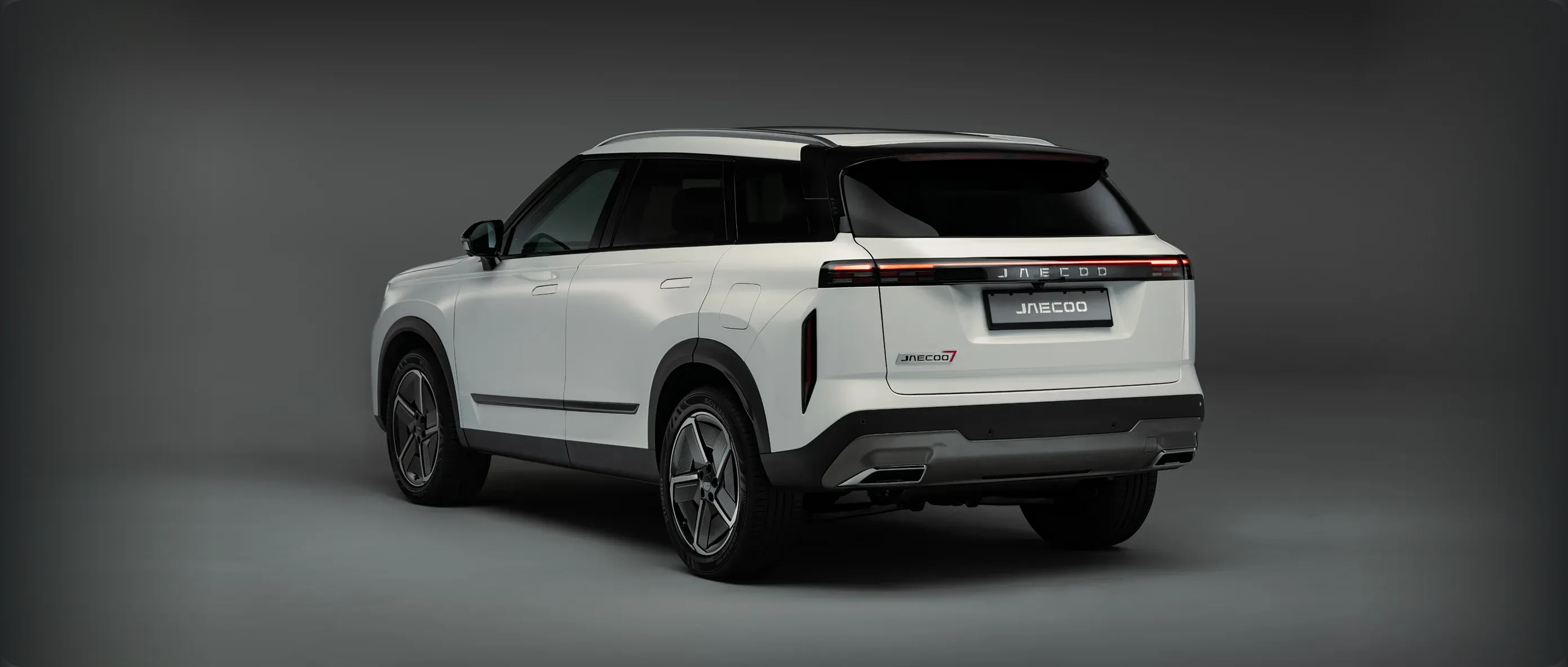
There is a moment when you first see the new Jaecoo 8 and think, hang on a second, I know what you’re doing here.
The stance. The bluff front end. The clean surfacing. The flush door handles. The big wheels. The broad-shouldered SUV shape. It is not a copy in the most literal sense, but let’s not dance around it, the Jaecoo 8 gives off very strong Range Rover Sport energy. And in the UK, that is not a bad place to start.

Because while plenty of buyers would love the look and road presence of a luxury SUV, not everyone wants the badge prestige pricing, the running costs or the image baggage that can come with it. Jaecoo seems to understand that better than most. The new 8 is basically saying, here is a large, high-spec, plug-in hybrid SUV with six or seven seats, 428PS, four-wheel drive, plenty of tech and a cabin loaded with toys, but for well under £50,000. Official UK pricing starts at £45,495 for the seven-seat Luxury and £46,995 for the six-seat Executive.
That immediately makes this one of the more interesting new arrivals heading to the UK this year.

And it matters because Jaecoo is no longer some obscure new badge nobody has heard of. The Jaecoo 7 has already proven that British buyers are far more open-minded than many legacy car brands probably hoped. In January 2026, the Jaecoo 7 racked up 4,059 registrations and finished as the UK’s second best-selling new car for the month. That is not a niche success story. That is a proper arrival.
So the Jaecoo 8 does not turn up as an outsider. It turns up with momentum.
What I find most interesting is that Jaecoo has not just made the 8 bigger than the 7 and called it a day. This feels like a deliberate move upmarket. You can have it as a seven-seat family SUV, or in Executive trim with a six-seat layout and proper second-row captain’s chairs. That second option feels especially telling. It says Jaecoo is not just chasing mainstream family buyers. It is trying to tempt people who like the idea of a more luxurious, more indulgent SUV without moving into traditional premium-brand territory.
The numbers are strong too
Official UK specs confirm 428PS, 580Nm and a 0-62mph time of 5.8 seconds, which is seriously brisk for a big plug-in hybrid SUV. UK reports also say it can manage up to 83 miles of electric-only range, which, if it translates even half-decently into real-world use, could make it a very usable PHEV rather than the usual token effort. Many plug-in hybrids look good on a brochure and then give you just enough battery range to feel mildly smug on the school run. The Jaecoo 8, at least on paper, appears to be aiming higher than that.
The equipment list is huge
Jaecoo’s UK site lists 20-inch alloys, torque-vectoring four-wheel drive, adaptive CDC suspension, a 12.3-inch digital instrument cluster, wireless Apple CarPlay and Android Auto, a Sony 14-speaker sound system, 50W wireless charging, over-the-air updates, online navigation, Wi-Fi hotspot capability and a connected app-based system. It also gets a long list of safety kit including curtain airbags, a centre airbag, eCall, ISOFIX and a 540-degree panoramic camera system.

That is the sort of spec sheet that would have looked fantasy-land stuff at this price point not very long ago.
Inside, it majors on comfort
The front seats are power-adjustable, the driver gets ventilation and memory, there is ambient lighting, a panoramic roof and a heated and cooled centre armrest, while the Executive adds reclining and folding second-row seats with massage. Massage seats in the second row. In a sub-£50k Jaecoo. That tells you everything about where the Chinese brands are pushing hardest right now. Not just lower prices, but higher perceived value.

The funny thing is, even if you ignore the styling conversation, the Jaecoo 8 still looks like a smartly judged bit of market positioning.
The Hyundai Santa Fe has gone big on visual drama. The Skoda Kodiaq remains one of the most sensible and complete family SUVs out there. Premium German SUVs still dominate aspirational buyer wish lists. Jaecoo seems to have looked at all of that and gone for a different route. Give buyers the wow factor, pile on the features, make it feel expensive, keep the powertrain relevant to UK needs and land it at a number that forces people to pay attention.
Yes, it really does look familiar
The design, though, will be what gets everyone talking first.
I can already imagine the comments sections filling up with the same line over and over again. It looks like a Range Rover Sport. And yes, from some angles, it really does. The waterfall grille is Jaecoo’s own, the rear light signature has its own shape, and the overall execution is not a straight photocopy, but the influence is obvious enough that pretending otherwise would be silly.
Still, car buyers have never shopped in a vacuum. Familiarity sells. Aspirational design sells. Road presence sells. If you can offer all three while undercutting more established rivals and throwing in a genuinely useful plug-in hybrid system, people will forgive a lot.
What will it be like to drive?
The more important question is what it will be like to drive.

Officially, we know it gets torque-vectoring four-wheel drive and CDC adaptive suspension, which at least suggests Jaecoo wants to talk about more than just touchscreen sizes and seat massage programmes. But until I get behind the wheel, that part remains the unknown. A big, heavy, high-powered plug-in hybrid can either feel surprisingly polished or surprisingly synthetic. There is not usually much middle ground.
First thoughts
So first impressions?
The Jaecoo 8 looks like one of the boldest statements yet from a Chinese brand in the UK. Not because it is cheap, because it is not exactly cheap. But because it understands what a lot of buyers actually want. Space. Style. Power. Presence. Tech. Reassurance. A premium feel without an eye-watering premium invoice.
And if it just happens to look a bit like a Range Rover Sport while doing all that, Jaecoo probably will not lose much sleep over it.